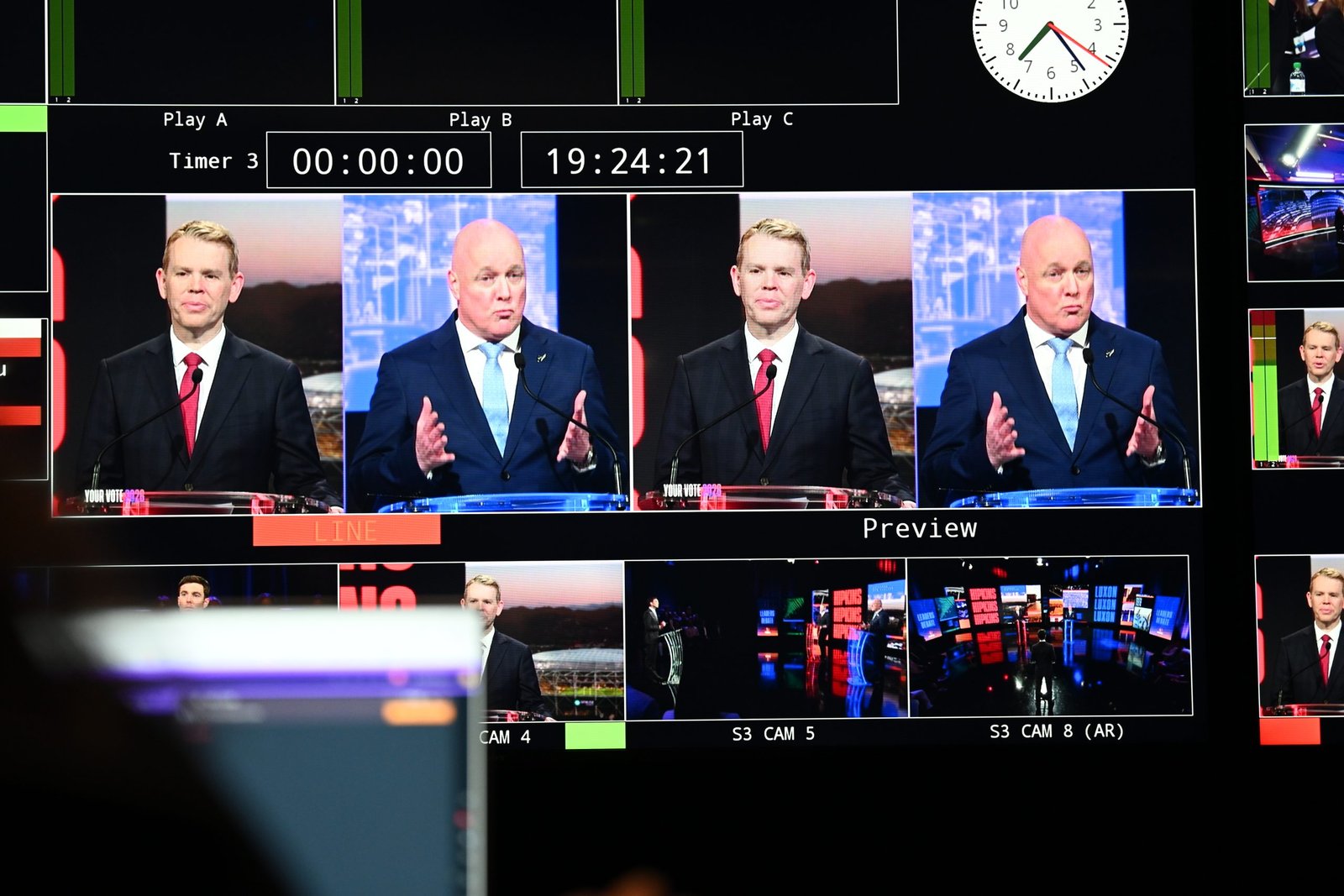
The first campaign debate between the leaders of the country’s two main political parties saw National’s Christopher Luxon and Labour’s Chris Hipkins trade blows over their respective records and who has the best vision for our future.
With a month to go until election day, there is precious little time for either leader to sway voters, making moments like Tuesday evening’s TVNZ debate even more important.
Below, some of Newsroom’s editorial team share their thoughts on what stood out to them from the proceedings:
Sam Sachdeva: The silence between the notes
Perhaps more interesting than what we heard from either Chris under the studio lights was what we barely heard.
‘No new taxes’, the National Party’s de facto campaign slogan, was barely mentioned by Christopher Luxon in contrast to the ad nauseum repetition of recent weeks – perhaps in recognition that playing one note endlessly may drive voters to insanity.
Labour leader Chris Hipkins also refrained from any accusations of “bullshit” or similarly salty language, although he did push back on some of Luxon’s accusations in equally scathing ways: “This is why people don’t trust you, Chris, because they know they can’t believe what you tell them.”
Viewers may have struggled to believe the National leader’s suggestion that Kiwis were already starting to feel the benefits of lower prices (“Some New Zealanders still are not, and there’s more for us to do,” he quickly clarified).
Hipkins largely had the better of Luxon on the cost of living, as well as other key issues like the health system that may have the defining say on the election outcome. But the Prime Minister did a strong job of prosecuting the last government’s record on education and law and order, and didn’t crash under the (admittedly low) bar set for his performance heading in.
Will this shift many votes? No. For all the people who tuned in, there will be far more who didn’t – and what snippets they do see in the coming days will be heavily shaped by the way they are cut together, with the parties already furiously firing out content on their social media platforms.
Sam Sachdeva is Newsroom’s associate editor
Tim Murphy: Leaders ‘more Dan Quayle than Lloyd Bentsen’
A reasonably consistent points win to Chris Hipkins.
Christopher Luxon is politically retentive. He retains information and details of his encounters with Kiwis and he retains lists. Always lists.
So Luxon is hard to stop when he gets on a verbal roll. For Hipkins, the challenge was to cut in, and he did well, at times: “You want to import LNG” when Luxon expressed pride in renewables.
Luxon couldn’t have liked the presentation of early progress scores from an undecided panel (68 to 32, 69 to 31, and 56 to 44 at halftime). Before that last result he’d discussed the India trade deal, tax and education.
He had two glitches: failing to confirm he’d won the toss and being unable to come up with one example of when he’d changed his mind.
Hipkins was caught out cold once, asked to choose between the Warriors winning the NRL or the All Blacks at the World Cup, trying to say it was an impossible ask, then opting for the Wahs, then later realising and in a later segment joking about his rugby test tickets and love of the national team.
When Luxon reached back with criticisms of Labour past, Hipkins condescended to him: “You keep wanting to go backwards. Focus on the future.”
Luxon was stronger on co-governance and division, rents and education (labelling Hipkins New Zealand’s worst minister).
Hipkins outpointed him on emergency departments and nurse numbers and rattled him on tolerating Winston Peters’ racism, after Luxon suggested “some of our political leaders have been pretending they are Nigel Farage or Pauline Hanson”.
Tame stopped their claims and counter-claims of policies being un-funded, which might have been to Luxon’s disadvantage, given how central it is to National’s whole campaign.
A vignette that will last: both men ruled out raising GST, but Hipkins goaded Luxon that “John Key made that promise and then broke it.”
Luxon retorted “I’m not John Key. You’re not debating John Key. You’re debating Chris Luxon.”
Hipkins: “You’re definitely not John Key.”
Luxon tried a recovery, but it took two stages: “And you’re not Helen Clark… [pause] although she runs your foreign policy.”
Neither managed a ‘You’re no Jack Kennedy’ moment of US debate fame there. But neither are Lloyd Bentsens. Sadly, they’re more like the man he slayed with that line, Dan Quayle.
Tim Murphy is Newsroom’s co-founder and co-editor
Cass Mason: A ‘consensus box’ lacking for goods
It always feels like a relief in a combative environment like a leaders’ debate when opponents agree, but Christopher Luxon was loath to budge on much. Jack Tame’s “consensus box” was pretty empty in tonight’s debate, but what it did contain was largely thanks to concessions from Chris Hipkins.
Changing one’s mind on policies can be both seen as weak, or as having considered evidence and taking things on board. When Hipkins said Labour would keep the phone ban in schools, despite having previously opposed it, Luxon hit back that it was quite the “flip flop”.
Which seemed like more evidence that Luxon, having earlier said he’d never changed his mind on anything, felt he perhaps does not have much to learn. Hipkins’ willingness to admit he had changed his mind on a capital gains tax, and that he would keep the Government’s gang patch ban, I think would appeal to viewers, and, as the numbers would suggest, undecided voters.
Part of the reason the Opportunity Party message appears to be landing with voters is its appeal to New Zealanders weary of disagreement for disagreement’s sake. Luxon’s refusal to budge on almost anything – including working with Opportunity – could have been perceived as decisive leadership by some, but more as arrogance by others.
Cass Mason is Newsroom’s news director
Jonathan Milne: A bull in the political china shop
Leaders’ debates are about the jab-and-parry, not about setting out one’s market stall of visions and values and other objets de vertu. It is not often that debates make a tangible contribution to our lives.
So the most memorable moments of the 2023 debates, when these two men last took their marks on the floor of a TV studio, were when Christopher Luxon blundered into making policy on the hoof. It happened more than once. And remarkably, his ad hoc policy-making has delivered for the country.
There was the promise in the Newshub debate to lower the age for free bowel cancer screening from 60 to 50; Luxon told Paddy Gower it made sense to do it, and went so far as to say he would match the age in Australia. Promised, and now being delivered (albeit in phases).
Or there was the undertaking to TVNZ’s Jessica Mutch McKay that he would sign a trade deal with India in his first term in office. Promised, and delivered.
There was no such bull in the political china shop clarity in this debate, but for those like myself looking out for policy made on the hoof, there was one moment that was just smashing.
It was when this week’s moderator Jack Tame was grilling Chris Hipkins over whether he’d keep National’s gang patch ban. “Yes,” said Hipkins. “Right,” said Tame.
So Luxon clearly felt the need to up the ante: “And I’ll put 1000 more gang members into prison,” he volunteered.
Hello, what? Do they have to commit crimes first? Does that mean Luxon is promising 1000 more serious violent crimes?
Do they have to be prosecuted and convicted and sentenced by the courts? Does this mean he’ll build another prison the size of Rimutaka, to house all his new inmates?
It was such an odd thing to say that some assumed he’d meant to claim success for the last term of government. Indeed, it was such an odd commitment to make that National Party strategists quickly rewrote it, pushing out a social post depicting Luxon at the debate podium and saying in quote marks, “I have put 1000 more gang members in prison.”
But I’ve checked back over the recording: it was a promise for the future. It evokes visions of Luxon chasing down Lambton Quay after some fleeing Hamburglar character, blowing red-faced on his police whistle. “Allo, allo! You’re nicked sunshine! You’re going in the clink…”
Though without their patches, it’s not quite clear how he’ll know which ones are the gang members.
Jonathan Milne is Newsroom Pro’s managing editor
Marc Daalder: Better robotic than looking out of touch
As I’ve written in my wrap of the debate, I think Chris Hipkins was the winner, by a narrow margin. He outperformed Christopher Luxon on the key questions around leadership: on foreign policy, where he took a stand when Luxon wouldn’t; on relatability, by owning up to pulling a sickie; and on prosecuting Luxon’s handling of remarks by his coalition partners that both party leaders agreed were racist.
Still, it was not a victory to proclaim from the mountaintops. In truth, neither Hipkins nor Luxon struck a deadly blow or made a fatal blunder.
Luxon’s camp will be relieved that he avoided a bout of his chronic foot-in-mouth disease. While he did not perform as well as Hipkins, he also had lower expectations to meet. After three years under Luxon’s premiership, no one in New Zealand is under the illusion that he’s a strong debater.
If he came off a bit robotic, well, that’s better than looking out of touch. And he surprisingly seized the upper hand on education, an area where Hipkins as a former education minister seemed to be on the back foot.
So who won the debate? Neither of the men on the stage. If they were hoping the prime time television audience would provide an opportunity to arrest their persistent slide in the polls, both Luxon and Hipkins will be disappointed. Instead, the winners are the party leaders who will take to the TVNZ stage in a week’s time for the minor party debate.
Marc Daalder is Newsroom’s senior political reporter