
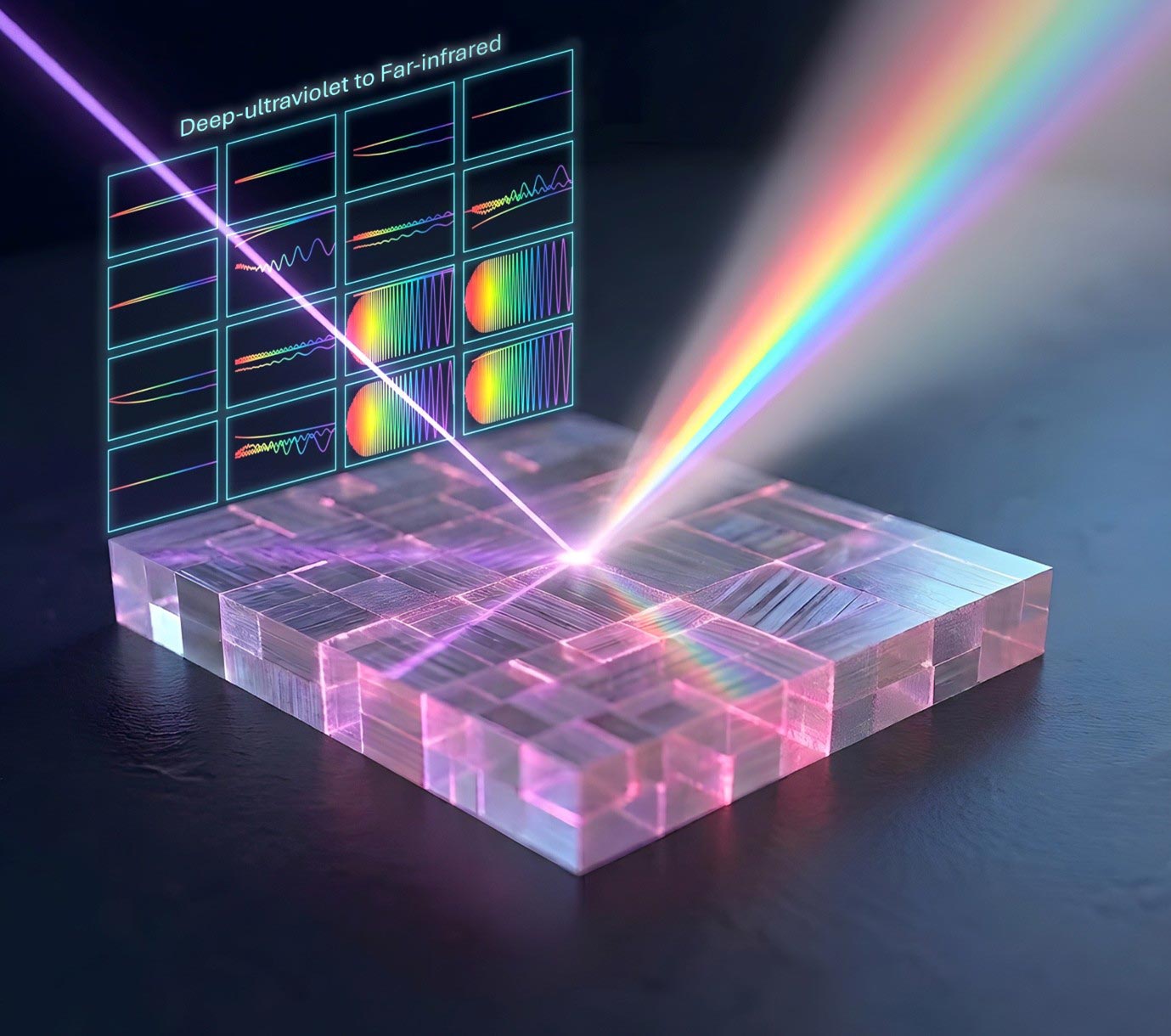
By untangling how the crystal barium titanate interacts with light, researchers have supplied data that could reduce costly trial and error in designing faster optical communication devices.
When light carries data through a communication device, absorption by the materials inside can weaken the signal. Engineers trying to build faster, more efficient devices need to predict how light will travel through those materials and how much will be lost before they commit to a design.
For a promising material called barium titanate, or BTO, those measurements have varied widely for decades. A KAIST-led research team has now clarified how it interacts with light, providing data that could help engineers design devices more reliably and reduce costly rounds of fabrication and redesign.
One crystal, different responses to light
BTO offers a useful way to control light because applying an electric field changes its refractive index, a measure of how much light slows as it passes through a material. Its strong response to an electric field, known as the Pockels effect, makes it promising for optical modulators. These devices use electrical signals to control light and encode information onto it.
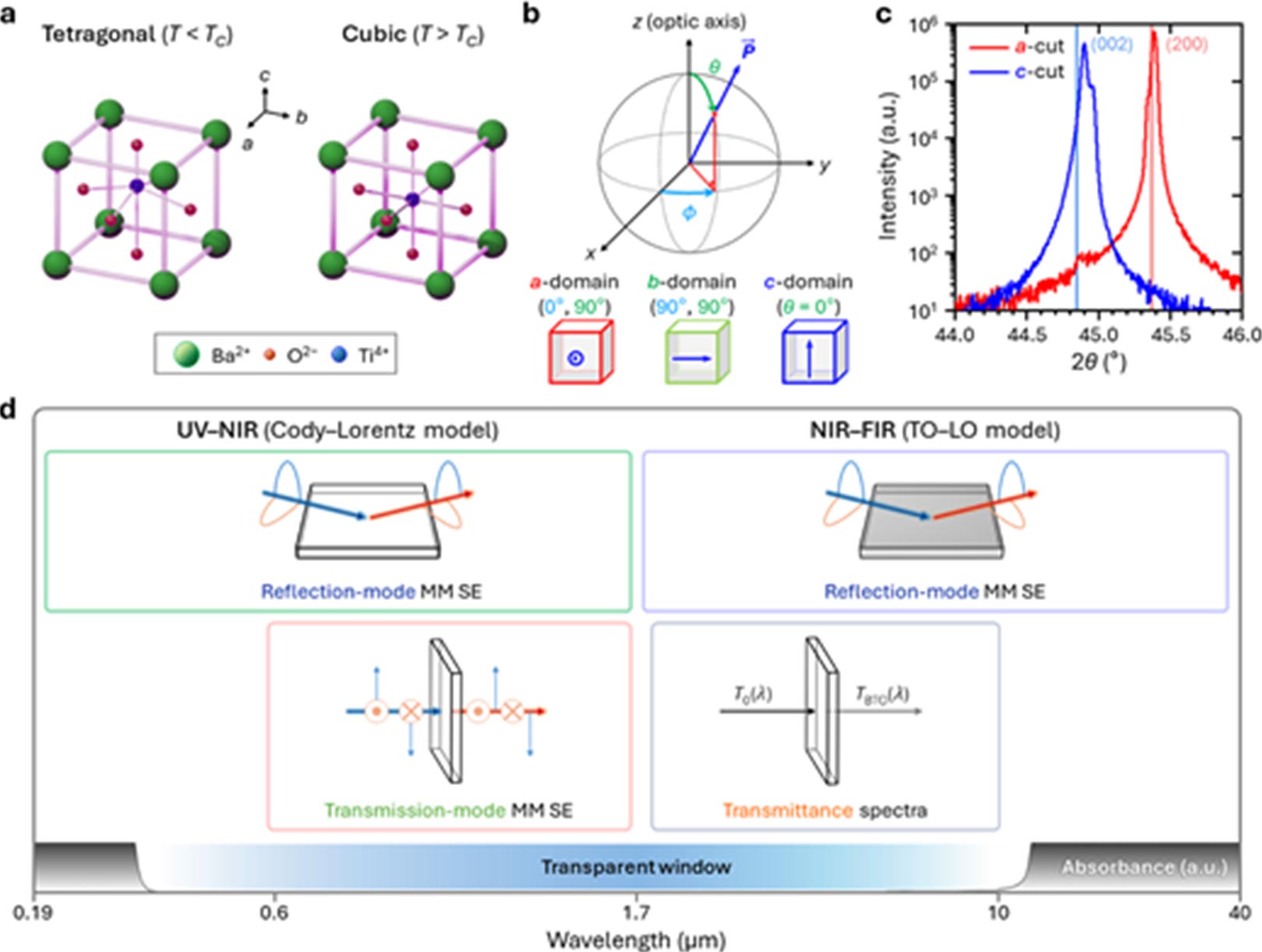
The difficulty is that a BTO crystal can contain small regions, called domains, with different crystal orientations. Those regions can interact with light differently, so measuring them together blends their responses. That makes it harder to determine the material’s underlying optical properties and predict how it will behave in a device.
To reduce that mixing, the team led by Professor Min Seok Jang of KAIST’s School of Electrical Engineering examined two types of single-crystal BTO samples with relatively uniform domain orientations. The researchers used Mueller-matrix spectroscopic ellipsometry, a technique that measures changes in light’s polarization, or the orientation of its electric-field vibrations, when it reflects from or passes through a material. Those changes provide information about how the material affects light.
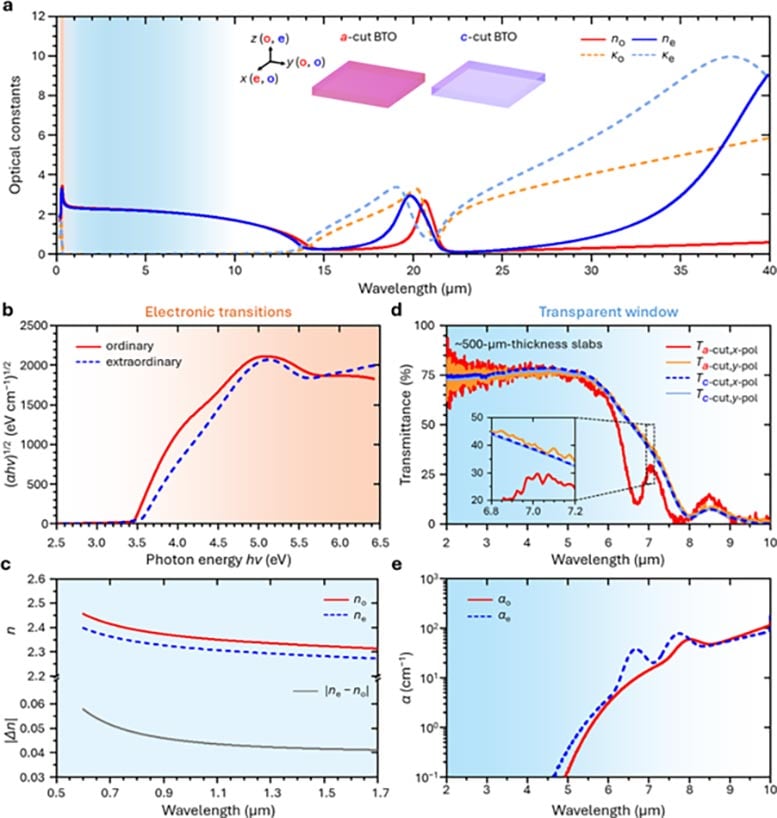
Their analysis covered wavelengths from 190 nanometers (nm) to 40 micrometers (μm), spanning the ultraviolet to the far-infrared. Because BTO interacts with light differently across that range, the researchers divided it into three spectral regions and used an analytical approach suited to each. They determined how the refractive index and absorption properties vary with both wavelength and crystal orientation.
The team also developed a method for calculating the overall optical response of a crystal containing differently oriented domains. Using the orientations and relative proportions of those domains, the method accounts for the mixed internal structure that had made BTO’s properties difficult to establish.

Measuring light loss in nearly transparent barium titanate
Even in the wavelength range where BTO is nearly transparent, the researchers were able to quantify very weak absorption. They combined ellipsometry with separate transmittance measurements, which record how much light passes through a sample, to determine extinction coefficients as low as approximately 10⁻⁵ in the 2–10 μm range. The extinction coefficient describes how strongly a material absorbs light, with smaller values indicating weaker absorption.
Together, these measurements help answer two practical questions about a waveguide, a structure that guides light through a device. The refractive index helps designers predict how the light will travel, while the extinction coefficient helps them estimate how much will be lost to absorption. Engineers can use the data to assess devices of different sizes and shapes before fabrication. Potential applications include communications modulators, devices that generate light at new wavelengths, and circuits that process quantum information using light.
KAIST, led by President Choongsik Bae, announced the work on November 8. The study was conducted in collaboration with Professor Harry A. Atwater’s team at the California Institute of Technology (Caltech), the Korea Research Institute of Standards and Science (KRISS), and U.S.-based J.A. Woollam Co.
“This study reveals the optical response of barium titanate, which had long remained unclear, and provides a reliable reference for how the material interacts with light,” said Professor Min Seok Jang. He added that the findings are expected to contribute to optical communication devices that reduce light loss and enable faster data transmission, as well as quantum photonic devices that require precise control of light.
Reference: “Broadband Optical Characterization of Tetragonal Barium Titanate by Mueller-Matrix Spectroscopic Ellipsometry” by Jiwon Kang, Nina Hong, Christopher M. Yi, Yun Su Go, Martin Thomaschewski, Hwi Je Woo, Prachi Thureja, Junghoon Jahng, Harry A. Atwater and Min Seok Jang, 20 October 2026, ACS Photonics.
DOI: 10.1021/acsphotonics.6c01514
This research was supported by the Culture, Sports and Tourism R&D Program through the Korea Creative Content Agency (KOCCA), with funding from the Ministry of Culture, Sports and Tourism; the Basic Science Research Program through the National Research Foundation of Korea (NRF), with funding from the Ministry of Education; the Ministry of Science and ICT; and the U.S. Air Force Office of Scientific Research (AFOSR).
Never miss a breakthrough: Join the SciTechDaily newsletter.
Follow us on Google and Google News.