
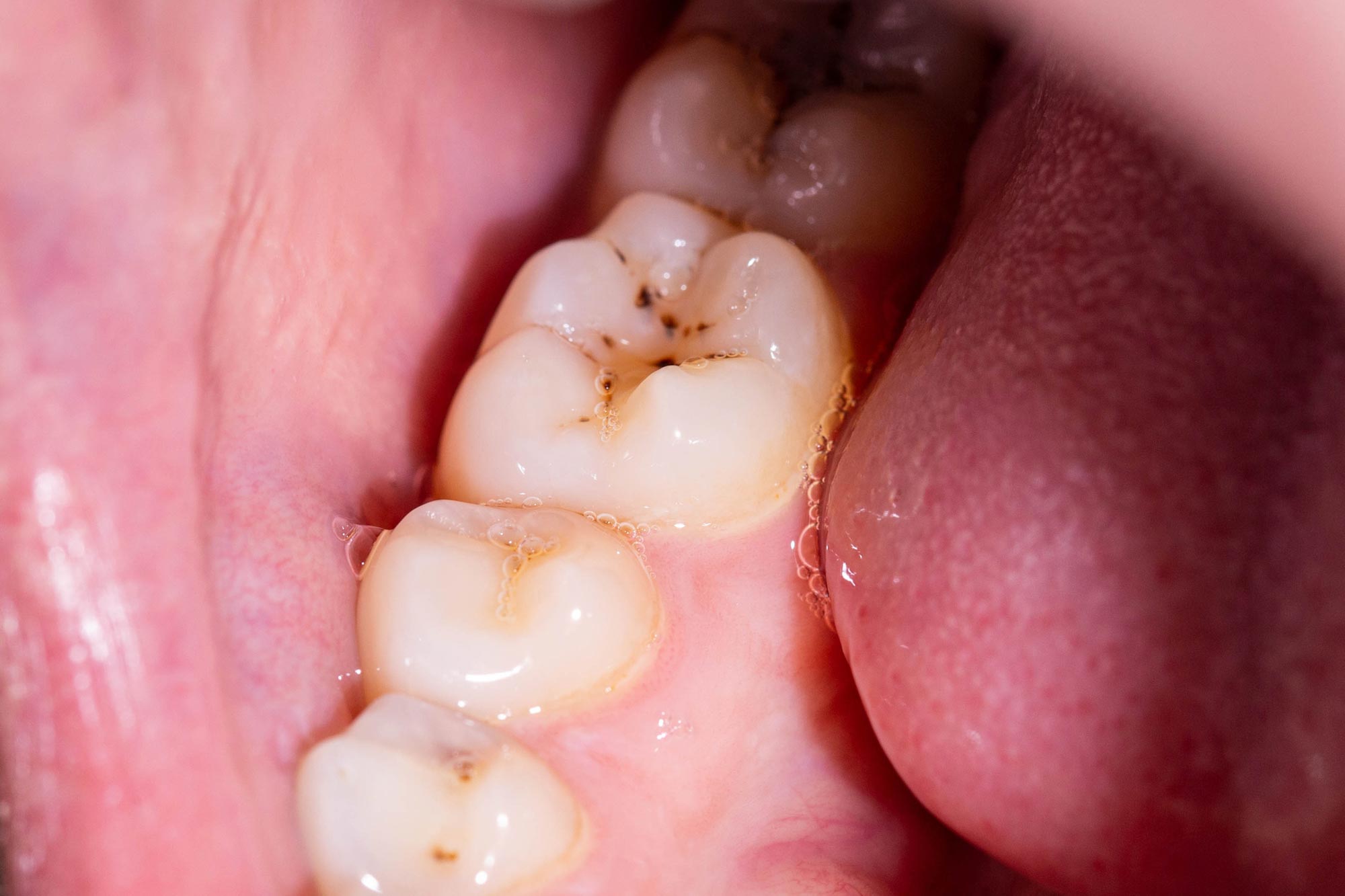
A simple, inexpensive liquid that takes only seconds to apply could spare thousands of children from painful dental procedures. New research led by the University of Michigan provides strong clinical evidence that silver diamine fluoride, or SDF, can safely halt tooth decay without drilling, injections, or sedation.
Each year, thousands of young children in the United States end up in emergency departments because of untreated cavities. Emergency physicians are often unable to address the underlying dental problem, leaving many children to endure pain and infection or eventually undergo surgery under general anesthesia.
SDF offers a much less invasive alternative. A dental professional uses a tiny applicator with a sponge tip to paint the liquid directly onto a cavity, a process that takes just a few seconds per tooth.
Dentists in many countries have successfully used SDF for decades. In the United States, it has been used off-label since 2014, when it received approval as a medical device for treating tooth sensitivity. However, obtaining approval from the U.S. Food and Drug Administration (FDA) as a drug for treating cavities has required additional evidence from large clinical trials involving U.S. patients.
The new University of Michigan study has now provided that evidence.
Major Clinical Trial Confirms Effectiveness Against Tooth Decay
Published in JAMA Pediatrics, the Phase III clinical trial involved 830 children younger than 6. Participants were recruited through dental offices, pediatric medical practices, and Head Start and Early Head Start programs across Michigan, New York, and Iowa.
The researchers found that applying a 38% solution of SDF every six months stopped the progression of decay in more than half of the affected baby teeth. Traditional cavity treatment typically involves removing decayed tooth material and restoring the damaged area with a filling. SDF requires neither of these steps and is instead applied directly to the cavity.
“This is a very effective and safe treatment—even in children as young as 1,” said Margherita Fontana, the study’s lead investigator and a professor of dentistry at the University of Michigan School of Dentistry.
A Simpler Alternative to Drilling and Filling
Tooth decay is the most widespread chronic disease among children, affecting more than 40% of children in the United States. Without appropriate treatment, cavities can lead to serious infections, intense pain, problems with eating and sleeping, school absences, and frequent trips to medical providers.
According to Fontana, SDF could be particularly beneficial for very young children, older adults, individuals with developmental or physical disabilities, and people with severe dental anxiety. It could also help patients who face barriers to obtaining conventional dental care or have difficulty tolerating traditional procedures.
The treatment does have one significant disadvantage, although it is primarily cosmetic. The silver permanently darkens the portion of the tooth affected by decay.
“If we want more children and families to benefit from this treatment, we need rigorous evidence showing both that it works and that it’s safe. From a public health perspective, if we want broader implementation across the United States, including in medical settings, we need carefully collected data in U.S. populations, and we now have that,” Fontana said.
Expanding Access to Early Cavity Treatment
The research project launched in 2018 and continued despite the disruptions caused by the COVID-19 pandemic. Its findings could help encourage the use of SDF beyond traditional dental offices, particularly in pediatric medical practices where young children often receive care long before their first dental appointment.
Treating decay earlier could prevent cavities from progressing to the point where children experience severe pain, develop infections, or require surgery.
“In medicine, clinicians want high-quality evidence before changing practice,” Fontana said. “It is important to have data they can refer to because young children often see pediatricians years before they ever visit a dentist, broader acceptance could allow many more cavities to be treated while a referral to a dental home is successful, and before they become painful, infected or require surgery.”
Paving the Way for FDA Approval
Fontana collaborated with researchers from New York University, the University of Iowa, and Indiana University, as well as the National Institutes of Health’s National Institute of Dental and Craniofacial Research, which contributed more than $12 million in funding.
The completed trial provides the clinical evidence the manufacturer needs to submit a drug application to the FDA for the treatment of dental caries, the medical term for tooth decay. Elevate Oral Care supplied the formulation evaluated in the study, Advantage Arrest 38% SDF.
Amr Moursi, a professor of pediatric dentistry at New York University College of Dentistry and a co-principal investigator on the study, believes the results could help make the treatment more widely available.
“Our results support FDA approval of SDF for managing arrest of tooth decay in young children. Removing SDF from off-label status would be an important innovation which could lead to increased utilization by providers, enhanced payments by insurers and more consistent product quality,” said Moursi.
Potential Benefits for Children and Adults
For some young patients, periodic applications of SDF may be enough to keep decay under control until the affected baby tooth falls out naturally.
Adults could also benefit from the treatment. SDF may offer a long-term solution in certain cases or help prevent further decay until a patient can afford or undergo a restorative dental procedure.
“For almost anyone, this can arrest the decay and stop the infection and the pain it causes,” Fontana said. “This could benefit many people.”
Reference: “Efficacy of Silver Diamine Fluoride on Young Children With Severe Early Childhood Caries: A Randomized Clinical Trial” by Margherita Fontana, Amr Moursi, Carlos Gonzalez-Cabezas, Divya Khera, Steven M. Levy, George J. Eckert, Barry P. Katz, Livia M. A. Tenuta, Marcia S. Campos, Elisabeta Karl, James Boynton, Courtney Chinn, Alex Sheen, Justine Kolker, John Warren and Emily Thorpe, 27 July 2026, JAMA Pediatrics.
DOI: 10.1001/jamapediatrics.2026.2567
Never miss a breakthrough: Join the SciTechDaily newsletter.
Follow us on Google and Google News.