The blue tsunami triggered by the November 3 midterm elections saw Democrats win not just Congress but also several governors’ offices. Some — like Ohio — were expected, while others — like Texas — came as a surprise. The new map has some implications for state-level gun law reform.
In the absence of comprehensive federal legislation, states are left to regulate guns. Over the past two decades, blue states have tightened their gun laws while red states have loosened them. Last week’s landslide unexpectedly opened up new avenues in states where gun reform had been largely written off.
Democrats flipped at least five Republican governor seats in the midterms, with victories by Keisha Lance Bottoms in Georgia, Rob Sand in Iowa, Aaron Ford in Nevada, Amy Acton in Ohio, and Gina Hinojosa in Texas. Meanwhile, Jonathan Kreiss-Tomkins is leading in Alaska, which hasn’t been called yet. Democrats also picked up one or both chambers of the legislatures in Arizona, Georgia, Michigan, Minnesota, New Hampshire, North Carolina, Pennsylvania, Texas, and Wisconsin — in some cases giving Democratic governors the trifectas they’d need to enact gun reforms.
Here are the possibilities for gun reform in states where Democrats took control.
A Few Incoming Governors Will Face a Divided Legislature
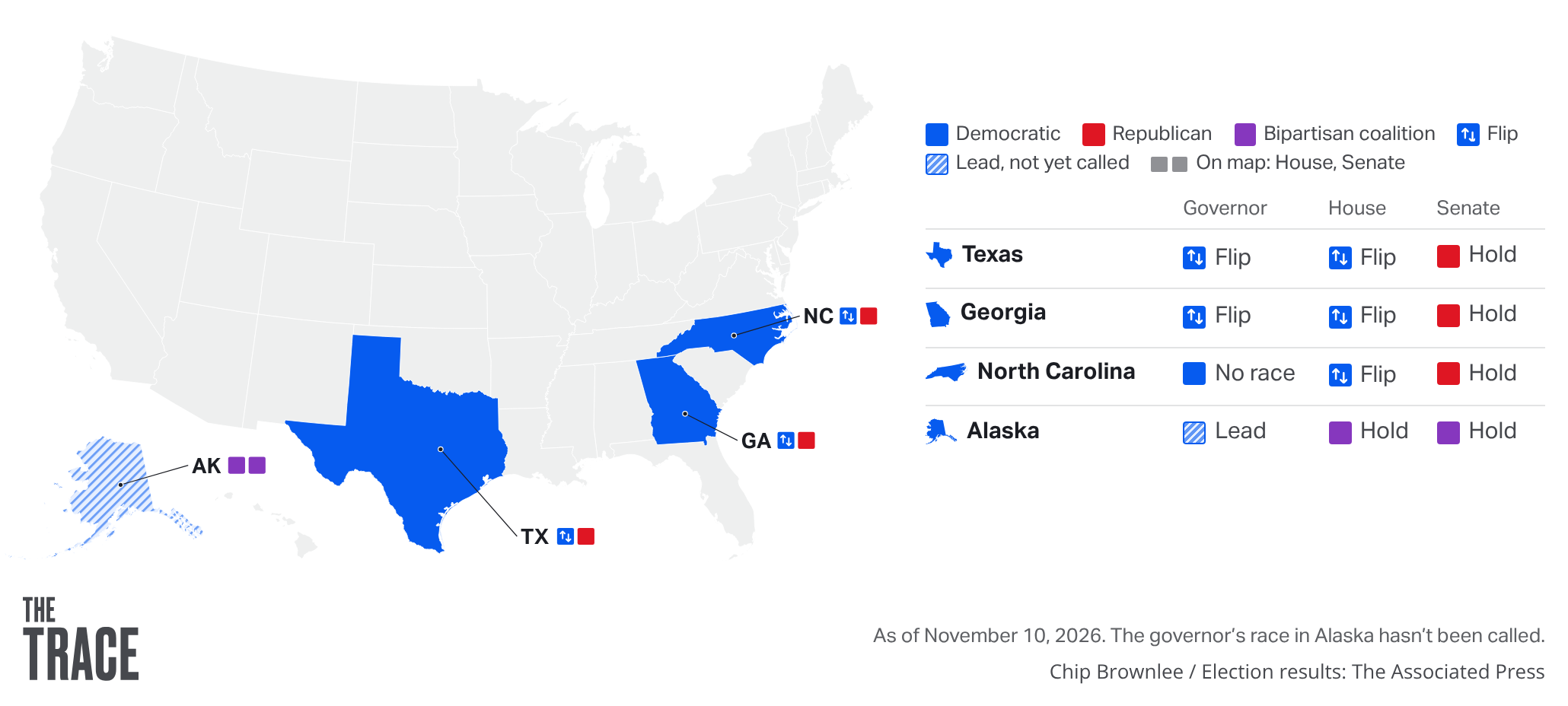
In Texas, Democrats flipped not just the governor’s office but also the state House of Representatives. The state Senate will stay in Republican hands and will remain a barrier to reform — though it will be led by the Democratic Lieutenant Governor-elect Vikki Goodwin, who defeated incumbent Republican Dan Patrick.
Goodwin is a March for Our Lives supporter who turned to gun violence prevention advocacy after her father was shot and killed in their family home in 1980. Goodwin, currently serving as a state representative, has been “probably our biggest champion in the House,” said Nicole Golden, executive director of Texas Gun Sense, a gun violence prevention group.
Golden said she expects the Democratic-controlled House to hold hearings on gun safety legislation, “which is something we almost never do,” she said. On her wish list: safe storage legislation and age restrictions for owning semiautomatic rifles. Golden also hopes the Legislature will reconsider a law enacted last year to prohibit local and state authorities from enforcing red flag laws, which allow courts to temporarily remove guns from people deemed dangerous.
There are things the incoming Governor Hinojosa could do without the Legislature, including through executive action. She could create a state office of gun violence prevention, which advocates in the state have sought for at least half a decade. “Progress will not be halted by partisanship,” Hinojosa vowed in her victory speech.

Joel Angel Juarez/Getty Images
Texas Democrats have pushed gun reform despite their minority status, including bills that would raise the age to buy semiautomatic rifles and require background checks at gun shows. Last session, lawmakers passed a bill to crack down on road rage shootings. But in most other instances over the past decade, the Legislature has weakened gun laws in the state, including by passing permitless carry in 2021.
Texas has a strong gun culture and a lot of gun owners, Golden concedes, but she said there’s also “broad support” among residents for the measures her group advocates. University of Houston polling from last year shows 89 percent support for universal background checks among Texans and 88 percent support for red flag laws. Less than a week after the midterms, Democrats filed several gun reform bills, including a repeal of the state’s ban on red flag laws, assault weapon regulations, gun storage requirements, and a repeal of the state’s firearms preemption law.

Elijah Nouvelage/Getty Images
In Georgia, Governor-elect Keisha Lance Bottoms will also face a divided Legislature. Outgoing Republican Governor Brian Kemp enjoyed a gun-friendly, GOP-led Legislature that also enacted permitless carry in 2022 and allowed more licensed concealed carriers to bring guns in from other states. Democrats flipped the state House in the midterms. Republicans will still control the Senate, but only by a thin two-seat margin.
Georgia Democrats have proposed bills in recent sessions that would ban anyone subject to a protective order or convicted of misdemeanor domestic violence from possessing guns, implement universal background checks, enact a red flag law, and set criminal penalties for leaving a gun accessible to a child. They all stalled.
Democratic state Representative Shea Roberts, who sponsored some of those bills, said she’s hoping the new governor will establish a state gun violence prevention center that will direct resources to communities for intervention efforts. In the Legislature, Roberts wants to see safe gun storage requirements and red flag legislation advance.
“I can’t speak at this point as to what the package will look like or what our strategy will be because there are a lot of people who are going to be involved,” she told The Trace. “But I can tell you that I will be actively working to get something done in this arena because I’ve had to fight numerous gun bills and watched permitless carry get passed.”
The GOP-controlled Senate is going to be a barrier, Roberts admitted, though with only a two-seat majority, Republicans won’t be able to afford a single absence. “At least in the House, we will control the agenda, we will control the messaging, we will control the resolutions, and we will control the bills,” she said. “Even if we can’t get everything we want passed, we’re going to be talking about things.”
Elsewhere:
- In Alaska, Democrat Jonathan Kreiss-Tomkins is leading the race to succeed outgoing GOP Governor Mike Dunleavy. Unlike with most states, the Alaska Legislature isn’t controlled by a single party; power is shared by a coalition of Democrats, Republicans, and independents. The midterms gave Democrats two more House seats. Democratic state lawmakers introduced gun reform bills last year that stalled, including measures to create a red flag law and ban machine gun conversion devices like switches.
- In North Carolina, Democratic Governor Josh Stein has contended with a GOP-controlled Legislature since he took office in 2025. This year, Democrats flipped the House and narrowed Republicans’ Senate majority to two seats. In recent sessions, North Carolina Democrats have pitched a red flag law and a comprehensive bill that would address safe storage, assault weapons, magazine capacity, waiting periods, bump stocks, age restrictions, ghost guns, lost and stolen gun reporting, and stand your ground laws, among other policies.
Some Democratic Governors Will Contend With GOP Legislatures

Scott Olson/Getty Images
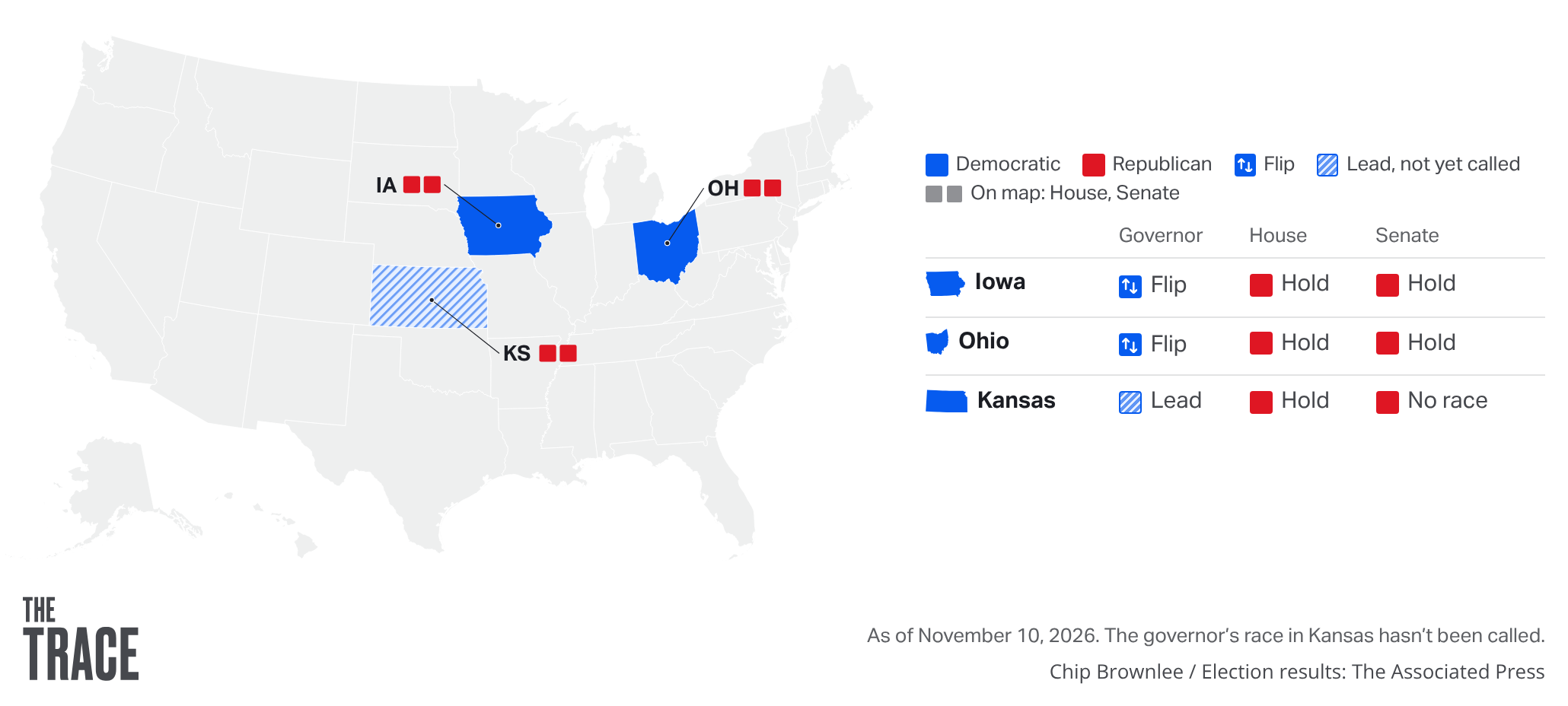
Democrat Rob Sand flipped the governor’s seat in Iowa, succeeding Republican Kim Reynolds. But he faces a hostile Legislature, which will retain its GOP supermajority. In the last session, Democrats tried to pass a universal background check bill, a measure requiring serial numbers on DIY firearms, a red flag law, and a training requirement for concealed carry permits. They all stalled.
In Ohio, Democrat Amy Acton will succeed Republican Mike DeWine as governor, but like Sand, she faces a solid red Legislature. Ohio Democrats recently proposed universal background checks and a red flag law, but neither passed.

Jeff Swensen/Getty Images
Cindy Holscher, who is leading in the race to succeed fellow Democrat Laura Kelly as governor of Kansas, would also contend with a GOP-controlled Legislature. But Democrats broke a 16-year-long GOP supermajority in the state House.
Without a Legislature to pass gun reforms, Kelly was limited to using her veto power to reject pro-gun bills. She vetoed measures to lower the age to carry concealed weapons, allow local school boards to provide National Rifle Association-backed gun safety programs starting in kindergarten, and earmark up to $5 million for gun-detection systems in schools. The GOP did not have enough votes to override her vetoes; they won’t next session either.
Several Governors Will Enjoy Democratic Trifectas
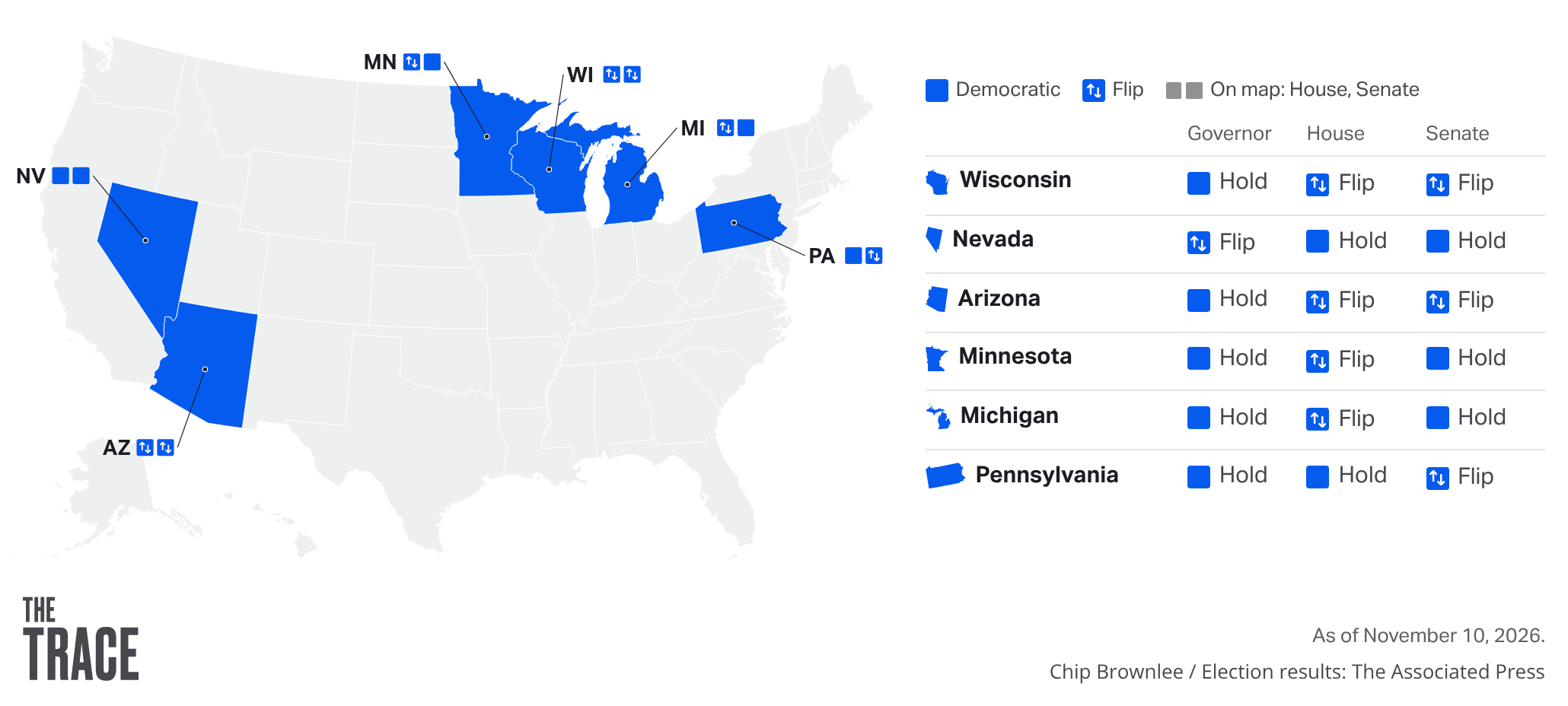
In Wisconsin, the Governor’s Office will stay in Democratic hands, with David Crowley succeeding Governor Tony Evers (and becoming the state’s first Black governor). But for the first time in nearly two decades, the Legislature will be under Democrats’ control, so Crowley will not face the same opposition that Evers did.
Wisconsin Democrats sponsored bills last session that would have extended background checks to all gun sales, established a mandatory 48-hour waiting period for handgun purchases, and created a red flag law. Democratic state Senator LaTonya Johnson, a sponsor of those bills, told The Trace that in the next session, Democrats are prepared to pass universal background checks, a red flag law, and a ghost gun ban. They also want to increase funding for community-based violence prevention programs.
“For more than a decade, Republicans used their gerrymandered majorities to block gun violence prevention legislation, refusing to give even the most basic gun safety bills a public hearing,” Johnson said. “With a Democratic trifecta led by Governor-elect Crowley, we finally have an opportunity to turn years of advocacy into action.”
Democratic state Senator Chris Larson, who also sponsored gun reform bills in the last session, told The Trace that Democrats taking control of the Legislature could end years of inaction on gun violence. “The calls for ending gun deaths and gun violence in our state have fallen on deaf ears,” he said, referring to Republican state lawmakers. “Now, there’s a chance to actually hear from survivors of gun violence and prevent the next tragedy.”
Larson said legislators will be looking at gun violence prevention policies that have been enacted in other states, including safe storage requirements, red flag laws, and universal background checks. He also wants to overturn Wisconsin’s firearm preemption law, which prohibits cities and towns from enacting gun laws that are stricter than the state’s. “There’s a lot we can be doing,” he said.
Elsewhere:

Ethan Miller/Getty Images
- In Nevada, voters elected Democrat Aaron Ford to succeed Republican Joe Lombardo. The Legislature currently has a Democratic majority and will remain in Democrats’ hands, giving the party a trifecta. Lombardo had been a barrier to gun reform, vetoing several gun reform bills in 2023 and 2025. Ford’s election removes that bottleneck, possibly setting up a scenario similar to the one we saw earlier this year in Virginia, where Democratic Governor Abigail Spanberger signed dozens of bills that her Republican predecessor had vetoed.
- Democrats flipped both chambers of the Statehouse in Arizona, where Democrat Katie Hobbs won a second term as governor. Currently, the Legislature is in GOP hands and has been a barrier to reform.
- In Minnesota, Democrats won the state House, giving them a trifecta, with Democrat Amy Klobuchar as governor.
- Democrats also took full control of the Legislature in Michigan by capturing the state House, with Democrat Jocelyn Benson as governor.
- In Pennsylvania, where Democrat Josh Shapiro handily won reelection, his party flipped the state Senate, giving Democrats a trifecta for the first time in more than three decades. They hope to revive long-stalled legislation aimed at curbing violence, The Trace’s Mensah M. Dean reported, including expanded background checks, a red flag law, and a ghost gun ban.
At Least One GOP Governor Will Contend With a Flipped Legislature
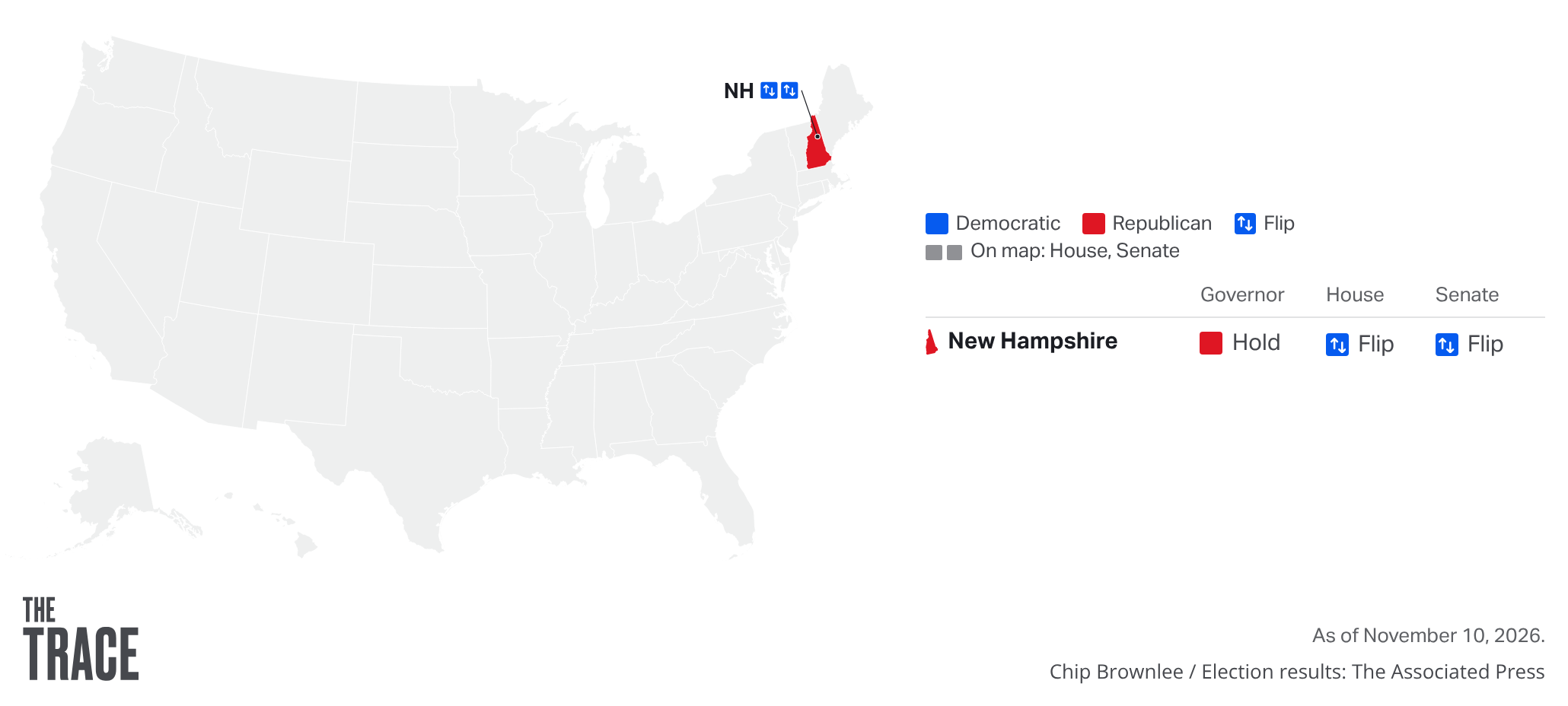
In New Hampshire, Democrats took control of both the state House and Senate, secured a veto-proof majority in the House, and came within one vote of a veto-proof majority in the Senate. The governor, Republican Kelly Ayotte, won a second term. The state has some of the most permissive gun access laws in the nation, including permitless carry. Last session, Democrats tried to advance a red flag measure, a safe storage requirement, and a ban on firearms in safe school zones, but they all stalled.
In the next session, which lasts two years, Democratic state Senator Debra Altschiller told The Trace that lawmakers plan to form a new gun violence prevention caucus and set policy priorities. The first year of each session is typically consumed by budget matters, so they’ll probably tackle gun reform in the second year, she said. “We really need to take the temperature of the new members to see where their threshold is.”
Altschiller, who’s starting her second term in the Senate in January, wants lawmakers to address liability laws that have been favorable to gunmakers. She also wants to close a loophole in mental health hospitalization reporting that allowed the perpetrator of a 2023 hospital shooting to buy a gun from a licensed dealer. Also on the list: safe gun storage requirements.
“Everything is back on the table,” Altschiller said. “We’re looking for bold moves that have staying power.”