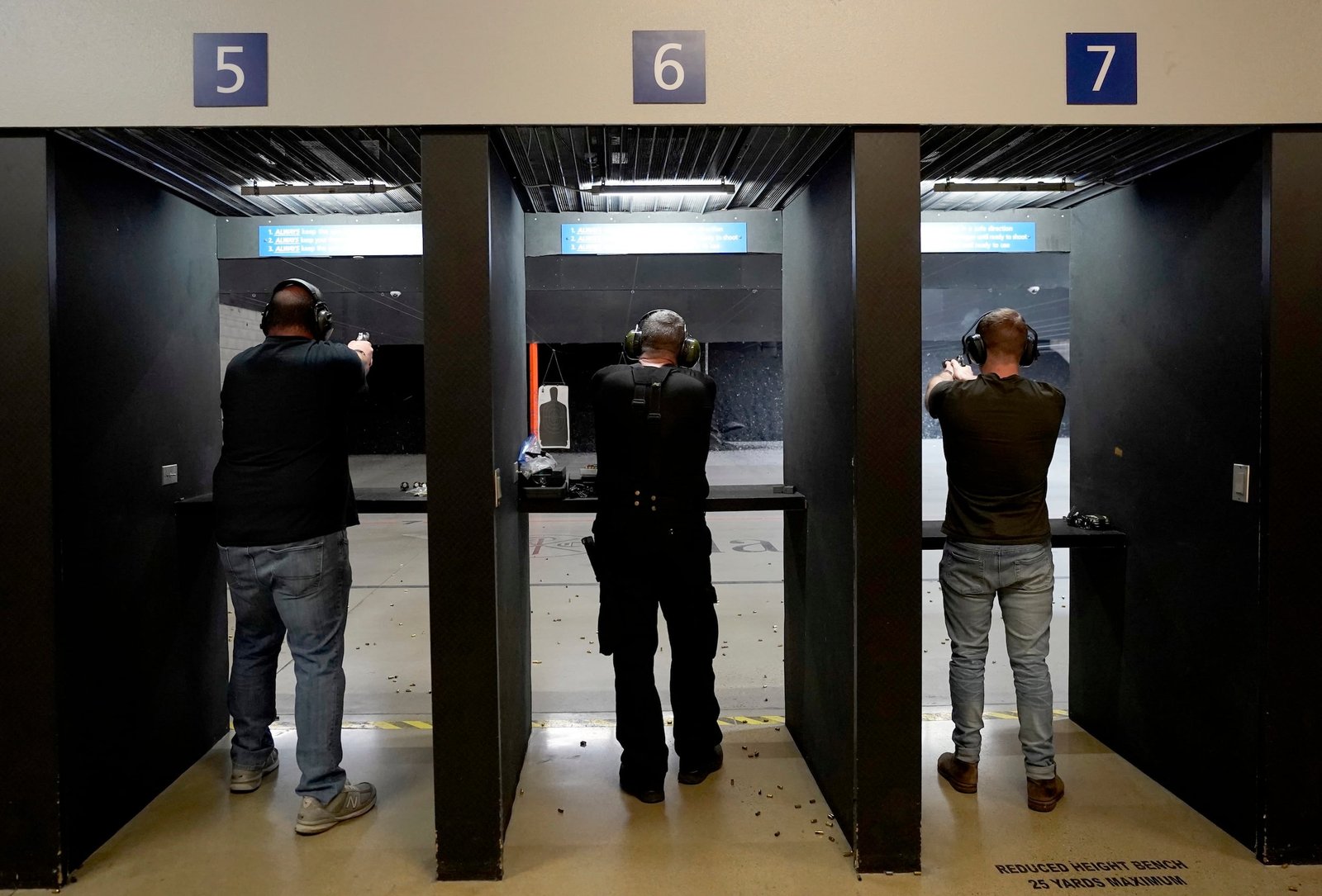

One year ago, the Justice Department’s Civil Rights Division sued the Los Angeles County Sheriff’s Department over alleged delays in issuing permits to carry concealed guns. It was the first in a flurry of litigation brought by the Trump administration to challenge gun restrictions, a cause championed by the president’s political base.
The Civil Rights Division has traditionally battled discrimination against marginalized groups based on race, sex, disability, and religion. But under the Trump administration, the unit has turned to gun owners, including them as an oppressed minority. The division opened a Second Amendment section in December to handle the caseload.
Over the past year, the Civil Rights Division’s Second Amendment section has filed 10 lawsuits, launched one investigation, and reached one settlement, according to an analysis by The Trace.
Three of the suits — in Los Angeles, the Virgin Islands, and Minnesota — concern gun permit application delays. In Denver, Washington, D.C., and Virginia, the division is challenging restrictions on semiautomatic rifles. The division is also trying to overturn Colorado’s limits on the capacity of ammunition magazines, California’s ban on pistols that are susceptible to being converted into machine guns, and the prohibition on carrying guns in public in Montgomery County, Maryland. This month, the division sued San Jose, California, alleging that the city’s $1,600 application fee for gun carry permits is exorbitant.
“It is disquieting to think of the federal government acting on behalf of the gun lobby and a small minority of gun enthusiasts to pressure state and local governments to abandon reasonable measures,” said John Donohue, a law professor at Stanford University. “The Trump administration initiatives are burdening state and local efforts to reduce gun violence.”
The Civil Rights Division’s most recent lawsuit, filed on September 24, challenges wait times for permits to purchase guns in Minnesota and the cities of Minneapolis and St. Paul. Under Minnesota law, police chiefs have up to 30 days after receiving an application to grant a gun purchase permit, but in those cities, some people have been forced to wait nearly 60 days, the complaint alleges.
That’s a far shorter delay than in Los Angeles County, where wait times for gun carry permits allegedly averaged nine months before the Civil Rights Division sued in September 2025. Last month, the two sides settled, with the Sheriff’s Department agreeing to “drastically cut” those wait times.
Most of the other lawsuits are making their way through the courts. A judge paused the challenge to rifle restrictions in Washington, D.C., while the Supreme Court considers a similar case; the justices’ decision is expected next year.
At the heart of the Civil Right Division’s gun rights-related work is New York State Rifle & Pistol Association Inc. v. Bruen, the 2022 Supreme Court case that established a right to self-defense outside the home and reshaped federal gun litigation. All 10 of the division’s gun rights suits cite the case. Bruen could prove particularly useful to the division’s efforts to overturn wait times and application fees for concealed carry permits: In a footnote to his majority opinion, Justice Clarence Thomas singled out “lengthy wait times in processing license applications or exorbitant fees [that] deny ordinary citizens their right to public carry” as being ripe for constitutional challenge.
Kostas Moros, director of legal research and education for the Second Amendment Foundation, which routinely challenges gun laws, said the Justice Department’s involvement in a gun case can act as a catalyst, inching it closer to resolution, and that he was happy to have the backing of the federal government on some of his group’s policy priorities. Moros’s group had filed suit over LA County’s permit wait times in 2023, but it wasn’t until the Justice Department got involved that the suit was resolved.
“We have been very pleased to see the Civil Rights Division’s new Second Amendment section be so active in its first year, finally returning to a mission the federal government first took up during Reconstruction,” Moros told The Trace, alluding to the post-Civil War-era Freedmen’s Bureau, created to protect the rights of formerly enslaved people. “I know some are deeply critical of this new focus, and prefer the Civil Rights Division only focus on defending the rights favored by progressives, but the Second Amendment is a constitutional right equivalent to any other.”
Legal experts we spoke to in June, however, said gun rights “have never been a focus” of the Civil Rights Division, and that the division is abandoning its duty to fight for marginalized communities.