LAST UPDATE
|
10 mins ago
THE DRUMCREE PARADE is “one of the most polarising parades in the history of Northern Ireland”, the Court of Appeal in Belfast has heard.
Denise Kiley KC, representing the Garvaghy Road residents, told the court today that the Parades Commission had a duty to promote an understanding of parading and it had failed to explain why it had reached its determination to permit the parade, particularly as it was the first time in 28 years it had not been banned.
Kiley told the court that “there is a duty to explain decisions”, particularly where “a decision has consistently been made on one basis for 28 years”.
Kiley was addressing the court today during a fresh bid against the planned Orange Order march in Portadown. The residents are challenging a decision of a High Court judge – made in the early hours of Sunday, 27 September – to refuse leave to apply for a judicial review of the commission’s determination to permit an Orange Order march down the predominantly nationalist road in Portadown later that day.
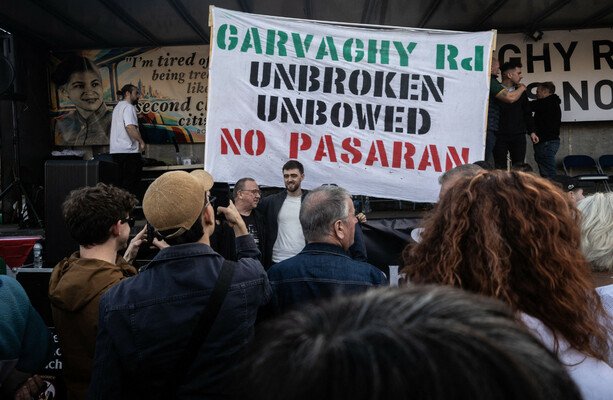
Residents in the largely nationalist area around the road – backed by Sinn Féin, the SDLP and People Before Profit – are opposed to the parade, which was due to start last Sunday morning, and unsuccessfully fought the decision in court.
Several of the residents then protested by blocking the 35-man contingent of the Portadown District Orange Order from progressing through Garvaghy Road, resulting in the Police Service of Northern Ireland (PSNI) refusing to give the Orange Order the go-ahead to proceed.
Under parading laws in Northern Ireland, protests must be notified to, and approved by, the Parades Commission adjudication body.
Opening the case today, Kiley said the question of whether the determination remained live – given the time and date of the originally permitted parade have now passed – remained an unresolved issue. However, she said the residents were not currently seeking a court determination on that point.
Outlining the basis of the appeal court challenge, she added: “There is a public interest in ensuring that the Parades Commission – a body charged with making these significant decisions on contentious parading issues – comes to correct and lawful determinations.”
Kiley said the Parades Commission failed to “properly weigh” what the police had told it about the potential for disorder if the parade was given the go ahead.
She said the commission’s assertion that there was no specific information from police about a risk of violence did not fully reflect what a senior commander had told it.
Kiley said PSNI Assistant Chief Constable Ryan Henderson had told the commission while police had no clear intelligence about any planned disorder he had also stressed that officers were dealing with an “unclear picture” and that, as a result, police were planning for various scenarios – from a peaceful passing of the parade to an outbreak of violent disorder.
Kiley said the commission’s subsequent conclusion that there was no specific information about the prospect of disorder was “only part of the picture”.
“It doesn’t go on to record the uncertainty and the fact that the position remained unclear,” she said.
“It is clear that what the police were telling the commission was this is unclear, it’s uncertain, and we are preparing for all eventualities.”
She said the commissioners “didn’t properly understand the police assessment” and this impacted their decision to permit the parade.
Kiley said the commission had therefore reached an “irrational conclusion”.
Dr Tony McGleenan KC, representing the Parades Commission, told the Court of Appeal that the determination to permit a limited parade down the Garvaghy Road should be read in its entirety.
“It is a detailed 31-paragraph written analysis,” he said.
“And it has to be read in its totality. And there is a grave danger of cherry-picking sentences here and sentences there to suggest a wrong legal test or a misdirection, or that something hasn’t actually been considered.”
McGleenan said police had given an assurance to the commissioners that they had the capacity to deal with any disorder that may have been triggered if a parade was permitted.
He insisted that the commission was “fully briefed” by police on the uncertainty around what might happen.
“They met with the PSNI on the 23rd (September) at a lengthy meeting with them. They were read intelligence briefings. They were briefed about the police resource and their ability to contain any disorder or reaction that occurred. So they have all of that.”
Kneecaps pays a visit
Meanwhile, Irish rap trio Kneecap visited Portadown to show support for the residents.
Móglaí Bap, Mo Chara and DJ Próvaí – Naoise Ó Cairealláin, Liam Óg Ó hAnnaidh, and JJ Ó Dochartaigh – went to a local school before meeting residents at Drumcree Community Centre on Sunday.
The Journal / YouTube
They then were swarmed by fans of all ages as they were led up the Garvaghy Road by the spokesman for the residents’ coalition, Breandán Mac Cionnaith.
The Belfast-based stars posed for selfies as volunteer stewards tried to keep fans off the road and allow the progress of vehicle traffic.
Hundreds of people had lined the street in advance of their arrival, but a stage which has been used for speeches in recent days was covered off and the three musicians did not perform or formally address the crowd.
They stopped briefly in a tent at the junction which leads up to Drumcree Parish Church – which is where the Orange Order is aiming to march from – before turning around and leaving the area by car.
In a statement to the Press Association after the visit, the trio said: “Kneecap support the residents of Garvaghy Road, they’re a determined and strong community.
“No community should have to live with sectarian intimidation, racism or hatred. Not here, not now, not anywhere.”
They were accompanied by their solicitor Darragh Mackin, who also represents the residents, as well as their manager Daniel Lambert and Irish folk singer Radie Peat.