Analysis: It starts like most media stand-ups.
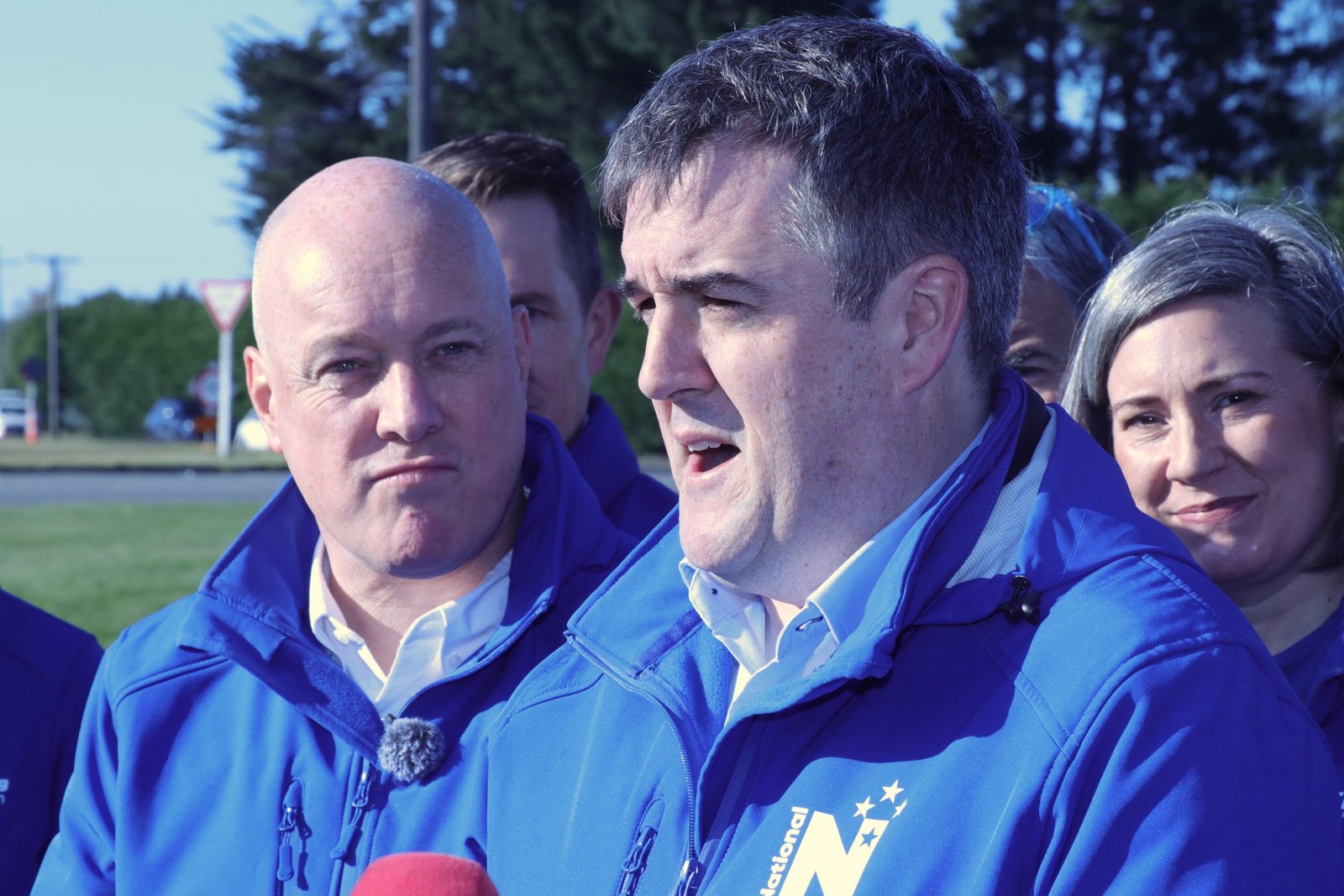
The TV crews, their breath visible in the cool Monday morning air, have checked the light and placed their cameras on a grassed area next to State Highway 1, just north of Christchurch. Microphone stands frame the highway scene as the police cars and diplomatic protection turn up.
And then, surprisingly, the cameras are on the move – at the urging of National Party figures, it seems, keen to get an NZ Transport Agency sign in the background. The highway could be anywhere, it’s argued, but the bypass sign is distinct to this place.
The TV folk hold firm, however, and the cameras return to the original spot,
Fresh from a round of radio interviews, National leader Christopher Luxon sweeps in, delivered by Crown limousine, only a few minutes behind schedule.
After hugging a line of blue-clad colleagues who provide the nod-and-smile wallpaper behind him, Luxon turns to the media and gives his own nod to the primacy of moving pictures.
“Tell me, are you all ready to go for your live streams and everything?”
Luxon starts by turning to his right and lavishing praise on Chris Bishop, his party’s transport spokesman, who, as Transport and Infrastructure Minister, is “doing an incredible job of getting this country and getting things done and built in it”. (That’s a verbatim word salad.)
Then, turning to his left, the National leader acknowledges Matt Doocey, who, since 2014, has been MP for Waimakariri – north of Christchurch and bounded, pretty much, by the Waimakariri and Ashley/Rakahuri Rivers.
Luxon says his local MP is “constantly, constantly banging on about Belfast to Pegasus”. “That’s right,” says a smiling Doocey, who took the Waimakariri electorate at the 2023 election by more than 13,000 votes.
Monday morning’s blaring car and truck horns – met by waves and thumbs ups from Luxon and Bishop – suggest it’s firmly in blue territory. A perfect place for a big-money announcement for a big road.

The ‘Belfast to Pegasus’ is one of the Government’s roads of national significance – an overly ambitious programme of 17 highways, the eye-watering, $56 billion cost which forced ministers to embrace particular projects and slow others.
The proposed 11km, north of Kaiapoi, will widen 4km of existing highway and, with the balance, create a new four-lane bypass, starting a stone’s throw of where Luxon is standing. Approval was granted through the Government’s fast-track consenting programme at the end of July.
A couple of kilometres north of the media scrum, State Highway 1 slices through the small town of Woodend where, at times, traffic snarls to a stop. Safety is an issue, especially for children who have to cross the highway to get to the primary school, Te Kura Tuatahi O Pakiaka Woodend School.
Between 2014 and 2023, there were 280 crashes on the highway through Woodend, resulting in three deaths and 25 serious injuries.
Over the past year or so, thanks to $127 million approved by NZ Transport Agency’s board, the land has been bought and initial works, including strengthening the Kaiapoi River Bridge, pursued.
When the staging plan was announced in July, however, the Woodend bypass was in limbo, with no money earmarked for construction.
That’s what the National leader wanted to address.
“We don’t want Canterbury’s progress to be held up by long queues at peak times, and particularly here in North Canterbury – a main street clogged up with trucks, and a poor safety record, isn’t what we want to see.
“Under this National Government, the Belfast to Pegasus motorway and Woodend bypass is finally moving after two decades of talk, and if re-elected, National will fund it, and we will get it built.”
If National is re-elected to government, Luxon says it is committing $800 million in the next Budget to “fully fund” both the highway upgrade and bypass, “and we will start construction next year”.
Bishop underlines it’s a “big amount of money; it’s a big road”.
This is typical of election announcements.
Newsrooms get day-in-advance notice of the party’s plans, but only minutes to digest details of the announcement. In this case, the embargoed email is sent out 28 minutes before Luxon is scheduled to speak.
That way, politicians can control the narrative – such as the benefits of its “sequenced plan” for highway projects. (Luxon talks up the “strategic clarity” of having a roads “pipeline”. “Actually, that’s been very, very helpful to actually make sure that, actually, these projects get locked in …”)
Asked whether the new road will be tolled, Bishop says National’s still pondering advice.
The public was consulted on two possible toll points, with $1.25 for light vehicles and twice that for heavy vehicles. In December last year, the NZ Transport Agency board considered its recommendation – which was subsequently provided to the transport minister. “The final decision on tolling rests with Cabinet on the advice of the minister,” the agency website says.

Newsroom asks Bishop if the pledged $800m will cover the total cost. (Note: Luxon said “fully fund”.)
The “investment envelope” is about $800m to $1b, he says, with National’s commitment “at the lower end”. (So, totting up, there is the initial $127m plus up to $1b for construction, making the potential total $1.13b.)
Any “overs” can be topped up from the National Land Transport Fund, he says – “but we don’t expect there’ll be very much of that”. “We do have quite a degree of certainty around it because the project’s just been consented.”
He leaves a little wiggle room.
“You never know exactly how much a road will cost until you go into procurement and then sign a contract to build the road. That will happen in the next year or so.
“But $800m we’re comfortable with, and it’s based on good numbers and based on the investment case.”
Bishop laments consenting delays and how that inflates costs. “You think about what happened under Labour.”
For this project, however, the fast-track expert panel took six-and-a-half, seven months, he guesses. (Actually, it took four-and-a-half, from being convened on March 11 to the decision on July 29.)
Newsroom harks back to 2023, when National’s transport policy document, ‘Transport for the Future’, estimated the 11km project would cost $270m. Now it might cost four times that. We ask: How did that happen?
“That would have been based on the costings at the time,” Bishop says.
“There’s obviously been a lot of construction cost inflation during the Covid years and throughout that period, so we’re using the most up-to-date information based on the NZTA investment case, which was done in 2025 and has been signed off by the NZ Transport Agency Board.”
Doocey adds: “In 2017, after the previous National government announced this as the next road of national significance, Labour came in in 2018 and cancelled the road. So we had six years of inaction, and that’s what’s driven up the cost.”
We point out Labour can’t have influenced an estimate made by National in 2023.
Bishop responds, reiterating that figure would have been based on publicly available information, Then he wants to look to the future. “We’re good to go and we’re going to get on with it.”
So when Labour’s figures are questioned, National accuses it – as Luxon did on Monday – of having appalling economic literacy.
Let’s remember, National released a $25b roads plan in July 2023, which ballooned out to $56b within three years and had to be pared back. But when it’s asked about one of those roads, and how a $270m plan could now cost four times that, it’s “based on the costings at the time”.
And that’s okay.
The Government is, instead, chalking up the wins because six of the 17 big roads will be under construction next year. Compare that to Labour’s Auckland light rail plan, Luxon says, and not a single metre of track was built.
Labour could well point to the Government’s poor track record on new ferries, or its broken promise to pump an extra $170m into electric vehicle chargers.
But its criticism of the roads of national significance started more than three years ago. Back then, transport minister David Parker called National’s numbers breathtakingly misleading, and billions of dollars short.
It’s always important to scrutinise a party’s rhetoric. But this election campaign might be important not just for what is said, but what isn’t.
On the campaign trail in September 2023, while announcing National’s intention to “supercharge” EV infrastructure, Luxon said: “We’ve got to get our emissions down, and the way we do that is we accelerate the transition to EVs.”
At the same press conference, National’s climate spokesperson Simon Watts committed to the next Government reducing emissions from transport and agricultural emissions in its first term.
Yet Government decisions have been criticised by the Climate Change Commission – a body the Act Party wants to scrap – for putting the country off track from its climate targets.
What would be telling is if National doesn’t release a specific transport policy describing how it would lower transport emissions, and invest in public transport. In other words, if it relies on what the Government is already doing, including building lots of roads, as a de facto policy.
That would show the Government’s largest coalition partner isn’t just widening the policy gap between itself and opposition parties, it will also mark a break with the National Party of 2023.
Newsroom asks Bishop, via email, how National intends to reduce emissions from transport, and if the party would have an EV-specific policy this election. We were provided with a statement from a National Party spokesperson.
“National is committed to increasing the number of public electric vehicle chargers across New Zealand to 10,000 by 2030. In August, the National Government opened the second round of zero interest loans to encourage private sector investment in charging infrastructure.
“The first round was incredibly successful, delivering more than 2500 new charge points. This is just one of a number of actions the Government is taking to encourage electrification in New Zealand and to give New Zealanders more control over their power bills and energy use.”
- This story has been updated with comment from a National Party spokesperson