Prime Minister Mark Carney’s government has designated a new West Coast pipeline project as being in the “national interest,” paving the way towards approval for a project to ship an additional one million barrels of crude oil daily to Asian markets.

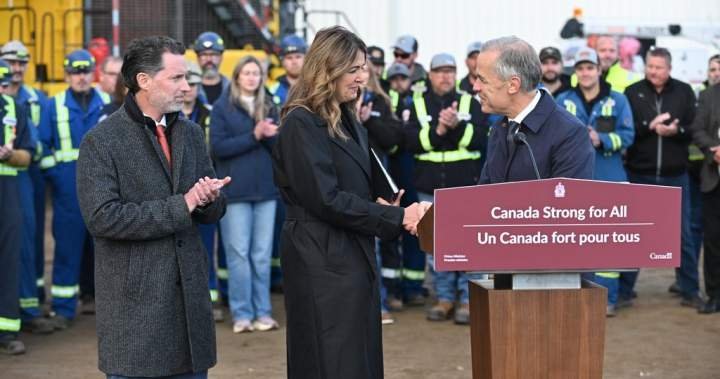
Carney made the announcement over the newly dubbed Pacific Link pipeline in Fort McMurray, Alta., Thursday flanked by Alberta Premier Danielle Smith.
“We have to do this, because the world is facing an energy crisis on three dimensions,” Carney said.
“There’s an immediate challenge of affordability and in some countries the very availability of hydrocarbons, there is a structural challenge of energy security and the existential challenge of climate change.
“These challenges are forcing countries to think differently about where their energy comes from and who they can rely on to supply it.”
Carney said that oil demand is expected to “continue to be significant for decades to come, even under any plausible net zero scenario.”

Global oil supply, meanwhile, is becoming more volatile with the U.S. war against Iran.
“So the question is, who will emerge as the world’s trusted suppliers? It should be us. It must be Canada,” Carney said.
The decision to classify the pipeline as in the national interest means it will fall under Carney’s Major Projects Office (MPO), a government branch meant to speed federal approvals for significant economic initiatives.
The project will still need to undergo a regulatory review by the MPO as well as public hearings led by the Canada Energy Regulator. The government is expected to then issue a “conditions document,” which would outline the requirements for the project proponents.
The MPO is expected to issue those conditions by Sept. 1, 2027.
The pipeline is expected to jointly owned by Trans Mountain Corporation (TMC), the Alberta Petroleum Marketing Commission (APMC), and the Pembina Pipeline Corporation. A minimum of 10 per cent equity in Pacific Link will be offered to Indigenous peoples.
Pacific Link would transport roughly one million barrels per day of crude from Bruderheim, Alta., to a deepwater port outside Delta, B.C., spanning approximately 1,250 kilometres.
The oil would then be loaded on large tanker ships for export to markets in Asia.
The project is a major test of Canada’s new major projects strategy and its ability to deliver regulatory certainty and predictable timelines, according to business management analyst Lance Mortlock, the managing partner of EY’s energy market segment and a University of Calgary associate professor.

Get weekly money news
Get expert insights, Q&A on markets, housing, inflation, and personal finance information delivered to you every Saturday.
“It’s signals that we want to build again,” said Mortlock, adding the announcement sends a broader message about Canada’s commitment to building infrastructure within globally competitive timelines.
“Markets will be watching less for the announcement itself, but more whether governments can now deliver that regulatory certainty, clearer timelines, and more predictable investment conditions.
“So now that process starts.”

In a briefing before the announcement, the government tied the decision directly to the trade war with U.S. President Donald Trump and the instability caused by his trade war.
“When you think about the geopolitical backdrop — tension in the Middle East, war — the world needs energy security and I think a lot of Asian markets are looking for diversification and optionality,” Mortlock said.
“Canada is coming forward, and I think it happens at a really important time.”
Oil and gas is Alberta’s biggest industry and global energy prices have a significant impact on provincial coffers, but the landlocked Prairie province has been hampered for decades by not enough shipping capacity to get product to tidewater.
“Resource wealth is only valuable if you can actually reach markets,” Mortlock said. “We’ve got all this resource wealth across this great country, but if we can’t get it to market, it’s not worth the wealth that we talk about.”
The need to diversify export markets, the government argued, is a matter of national sovereignty.
“Today, 90 per cent of Alberta’s oil goes to the U.S.,” Carney said. “Pacific Link will materially reduce that dependence by allowing us to export an additional one million barrels a day to growing markets in Asia.”
“That means more customers, more choice, and higher prices for all Canadian energy producers.”

In a statement, NDP Leader Avi Lewis blasted the Carney government for committing public money to back a pipeline in the midst of the climate crisis, and suggested the project would face legal challenges making it “not worth the risk.”
“Throwing billions in public money behind a pipeline at a time of climate breakdown – while sweeping aside environmental protections, meaningful Indigenous consultation and workers’ right to strike – is absolutely not in the national interest,” Lewis said.
“Projects that truly serve the national interest would lower costs, create good jobs, and protect the people and places we love — like renewable energy projects, 21st-century public transit systems to connect our communities, and a massive build-out of non-market housing Canadians can actually afford.”
But while Lewis criticized the government for “rushing” the pipeline’s approval, the Conservatives faulted the Liberals for taking too long.
Carole Anstey, the Conservatives’ natural resources critic, says the party wants the pipeline built but noted Thursday’s announcement was not putting “shovels in the ground.”
“I think Canadians certainly heard a promise from the prime minister to move at speeds not seen in generations … We would like to see this move forward at the speed that the prime minister promised,” Anstey said in an interview.

Oil and gas producers have, in recent years, shied away from big-ticket extraction investments — in part due to a shortage of pipeline infrastructure to bring their oil to market.
Industry has welcomed Ottawa’s moves to simplify the regulatory process, roll back Trudeau-era environmental policies and beef up tax incentives for new investments.
Smaller scale, shorter-term pipeline expansion projects are now in the works heading to the U.S. and West Coast.
“We will start to see the companies develop big capital projects again,” Mortlock predicted.
“Do I think that we’re going to see the mega mines that we saw 10 years ago? Probably not. But do I think we’re going to see 150,000, 200,000-barrel-a-day in situ expansion? Yeah, for sure,” Mortlock said, referring to steam-driven operations with a smaller footprint.
A TD Economics report released this summer said the potential pipeline would boost oil exports by 20 per cent and more than double what Canada currently sends to Asia via tankers.
“The opportunity is not just the pipeline, the opportunity is proving that Canada can once again execute large nation-building projects that attract capital, strengthen trade competitiveness and create Indigenous prosperity and improve economic sovereignty,” Mortlock noted.
“The risk is that Canada proves it can announce faster than it can deliver. So what we need to do now is back it up to say, ‘we can announce fast — but we can deliver fast too.’”
But whatever economic benefits a pipeline project brings, it carries both environmental and political risks for the Carney government.
The prime minister attempted to cushion that blow Wednesday, announcing that the federal government would commit $1.2 billion for ocean protection projects in B.C., where Carney has also backed proposed expansion to the Port of Vancouver.
With files from Lauren Krugel, The Canadian Press