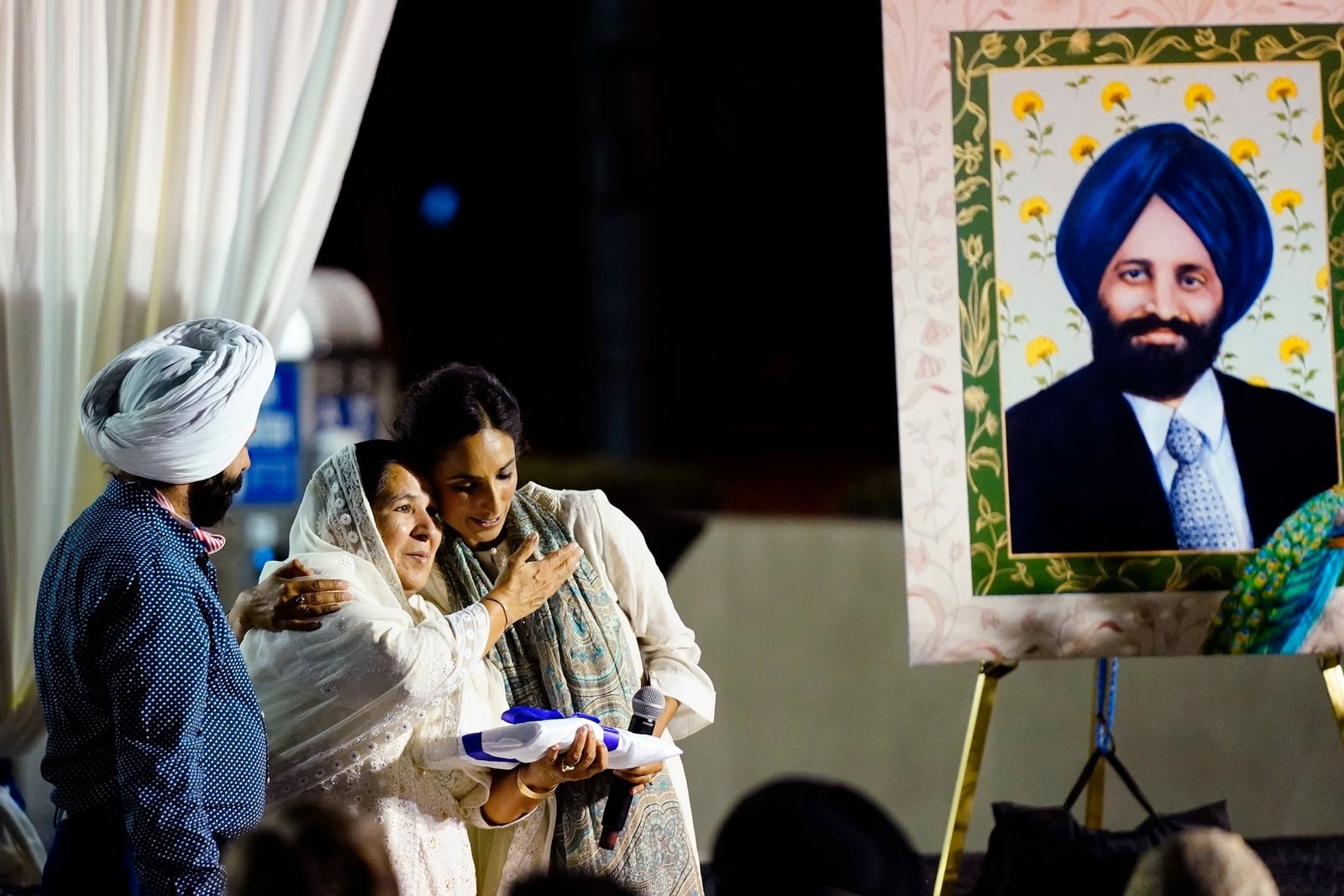

Four days after the terrorist attacks of September 11, 2001, a man in Mesa, Arizona, drove to a gas station and gunned down its owner, Balbir Singh Sodhi. The shooter had just been ranting about immigrants at a local sports bar and believed he was avenging the attacks.
Sodhi, a 52-year-old Sikh from India who “radiated love everywhere he went,” was planting flowers for 9/11 victims at his Chevron station when he was killed. The shooter then drove to another gas station and shot at a Lebanese-American clerk, missing him. “I’m a patriot,” the suspect said as he was arrested. “I’m a damn American all the way.”
Sodhi was one of at least 13 people shot in the aftermath of 9/11 by people seeking revenge for the attacks, 12 of them fatally, according to a Trace analysis of contemporaneous news clips, reports from human rights organizations, legal analyses, and the congressional record.
Hatred toward Arab and Muslim people, and people perceived to be Arab or Muslim, spiked in the aftermath of 9/11. Among the post-September 11 shootings we identified, only a few of the victims were Arab Muslims. Several were Indian Sikhs, who wear turbans similar to the head wrap that was worn by Osama bin Laden, the Saudi terrorist who planned and financed the 9/11 attacks. A few of the victims were Christian. All but one of the victims were shot at their workplace.
In the days after 9/11, then-President George W. Bush and his attorney general sought to tamp down the hate with speeches and statements that Islam was a religion of peace, and that South Asians were also among the 9/11 victims and should not be grouped with the terrorists.
Despite Bush’s efforts to keep the peace, incidents of violence continued. On the same day Balbir Singh Sodhi was killed, a neo-Nazi in Texas embarked on a shooting spree. He killed two people and wounded a third over the course of a month.
Waqar Hasan, 46, a Muslim Pakistani convenience store owner in Dallas, was shot in the head as he grilled hamburgers.
Vasudev Patel, 49, a Hindu from India, was killed while working at a gas station in nearby Mesquite. The only survivor of the spree, Rais Bhuiyan, a 28-year-old former air force pilot from Bangladesh who was shot as he worked his cashier shift at a gas station in Dallas, was partially blinded by the shotgun blast.
After his attacker was sentenced to death, Bhuiyan fought to spare his life, to no avail — he was executed in 2011.
Eight days after 9/11, Ali Almansoop, 44, a native of Yemen, was shot and killed in suburban Detroit by his girlfriend’s ex-boyfriend. “I’m going to kill you for what happened in New York and D.C.,” he said before opening fire. He was sentenced to life in prison.
A few days earlier, Adel Karas, 48, an Egyptian Christian, was fatally shot at his Los Angeles-area corner store. Police said at the time that it was an attempted robbery, but nothing was stolen from the register or from Karas’s wallet. Several of the post-9/11 hate crime shootings were initially written off by police as attempted robberies, characterizations that were vehemently disputed by victims’ families and reassessed in later years.
Most of the fatal post-9/11 hate crime shootings took place in the month after the attacks. But four of the victims were killed in early 2003 by a New York City man who claimed he wanted to kill Arabs in revenge for the September 11 attacks. He fatally shot four store clerks in Brooklyn and Queens in February and March of that year. Only one was of Middle Eastern origin.
Post September 11 hate crime shootings:
September 15, 2001: Balbir Singh Sodhi, 52, was killed at the gas station he owned in Mesa, Arizona. The shooter had just been ranting about immigrants in a sports bar. He then drove to another gas station and shot at a Lebanese-American clerk. He was sentenced to life in prison and died in 2022.
September 15, 2001: Waqar Hasan, 46, a Muslim Pakistani convenience store owner in Dallas, was killed by a neo-Nazi seeking revenge for 9/11. Hasan was shot in the head as he grilled hamburgers.
September 15, 2001: Adel Karas, 48, an Egyptian Christian, was fatally shot at his corner store in San Gabriel, California. Police said at the time that it was an attempted robbery, but nothing was stolen from the register or from Karas’s wallet. His family believes it was a 9/11-related hate crime, and members of Congress have referred to his killing as such.
September 19, 2001: Ali Almansoop, 44, a native of Yemen, was shot and killed in Lincoln Park, Michigan, by his girlfriend’s ex-boyfriend. According to his confession to police, he said, “I’m going to kill you for what happened in New York and D.C.” He was sentenced to life in prison.
September 21, 2001: The neo-Nazi who killed Waqar Hasan shot Rais Bhuiyan, 28, a former air force pilot from Bangladesh, as he worked his cashier shift at a gas station in Dallas. Bhuiyan survived, but was partially blinded by the shotgun blast.
September 29, 2001: Abdo Ali Ahmed, a 51-year-old Arab Muslim from Yemen, was fatally shot while working at his convenience store in Reedley, California. Nothing was taken from the register. His family believes it was a hate crime. Two days before the shooting, Ahmed, an American citizen who’d spent 35 years in the U.S., found a note on his car that said, “We’re going to kill all of you [expletive] Arabs.” He left behind eight children.
October 3, 2001: Abdullah Mohammed Nimer, 53, a Palestinian American door-to-door clothing salesman, was killed while making his rounds in Los Angeles. Police said it was a robbery, but his car was filled with thousands of dollars worth of merchandise and no money was taken. He was the father of six children.
October 4, 2001: The neo-Nazi who killed Waqar Hasan and wounded Rais Bhuiyan shot and killed Vasudev Patel, 49, a Hindu from India who worked at a gas station in Mesquite, Texas. The shooter was arrested October 5 and executed by the state of Texas in 2011.
October 17, 2001: Ramez Younan, 50, a Syrian-born Christian, was shot to death in the liquor store he owned in Los Angeles. No money was taken from the cash register.
February 8 to March 20, 2003: A New York City man who said he wanted revenge for 9/11 shot and killed four store clerks: John Freddy, 42, a Guyana native of Indian descent; Sukhjit Khajala, 50, an Indian immigrant; Albert Kotlyar, 32, a Ukrainian immigrant; and Mohammed Ali Nassir, 54, a Yemeni immigrant.